
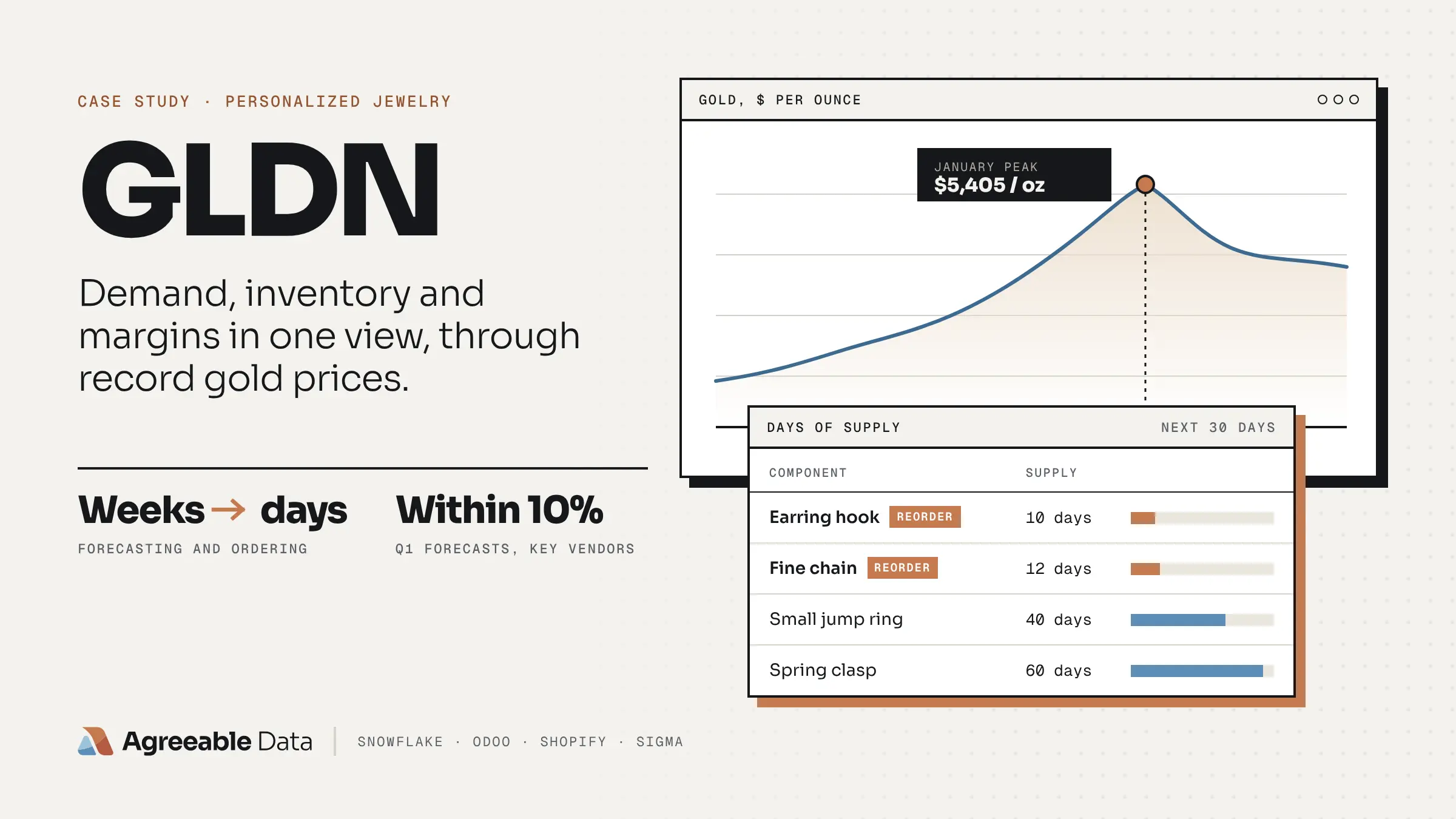
Built with: Snowflake, Odoo, Shopify, and Sigma.
Project highlights
- Cut forecasting and ordering from weeks to days.
- Brought Q1 2026 forecasts within 10% for key outsourced vendors.
- Added stockout alerts and days-of-supply visibility.
- Maintained contribution margins through material-cost increases.
About GLDN
GLDN is a US-based direct-to-consumer jewelry brand with a studio in La Conner, Washington. It specializes in handmade, personalized jewelry. Since each piece is personalized, GLDN customers can choose their metal and size, as well as customizable details such as initials, names, or dates.
Preparing for seasonal demand and fluctuating material costs
GLDN wanted a clearer view of its business: What were customers buying? Where was inventory going to fall short? How were product costs impacting margins?
Jewelry is a seasonal business. Every year, demand spikes around gift-giving occasions such as Mother’s Day or Christmas. Running out of a popular piece during these times means lost sales are not recoverable. In addition, seasonal demand and fluctuating gold and silver prices make purchasing and pricing decisions closely intertwined.
The team needed to be able to connect product demand, inventory, and product costs so they could buy ahead of seasonal peaks, spot shortages in time to act, and price products to protect margins.
A slow, manual process
GLDN’s teams relied on shared spreadsheets to plan purchases and review pricing. Preparing the numbers took substantial manual work and often depended on a few people with detailed knowledge of the data and calculations.
As a result, forecasting and vendor ordering took weeks, while pricing reviews happened only every few months. Add seasonal demand and fluctuating material costs, and the process became even harder to manage.
Forecasts built for seasonal purchasing
Agreeable Data built a centralized data warehouse in Snowflake, bringing together data from Odoo (ERP), Shopify, and other marketing and operational systems. The team then created comprehensive data models for products, orders, customers, and inventory, giving the company a unified view of each across its systems.
For example, the order model connected e-commerce purchases with ERP records and shipping details, while the inventory model linked stock levels with product listings and customer purchase history. Together, these models provided a foundation for forecasting seasonal demand and planning purchases.
Once the foundation was in place, the team could build demand forecasts for holiday purchasing and other busy periods.
GLDN selected Sigma as the final Business Intelligence delivery layer. This gave the team interactive planning tools alongside the forecasts. They also gained visibility into how long inventory was expected to last and received proactive alerts about stockout risk.
Finally, the team had the information at their fingertips to make better decisions. With the right level of detail and data joined across systems, purchasing could quickly decide what to order and when.
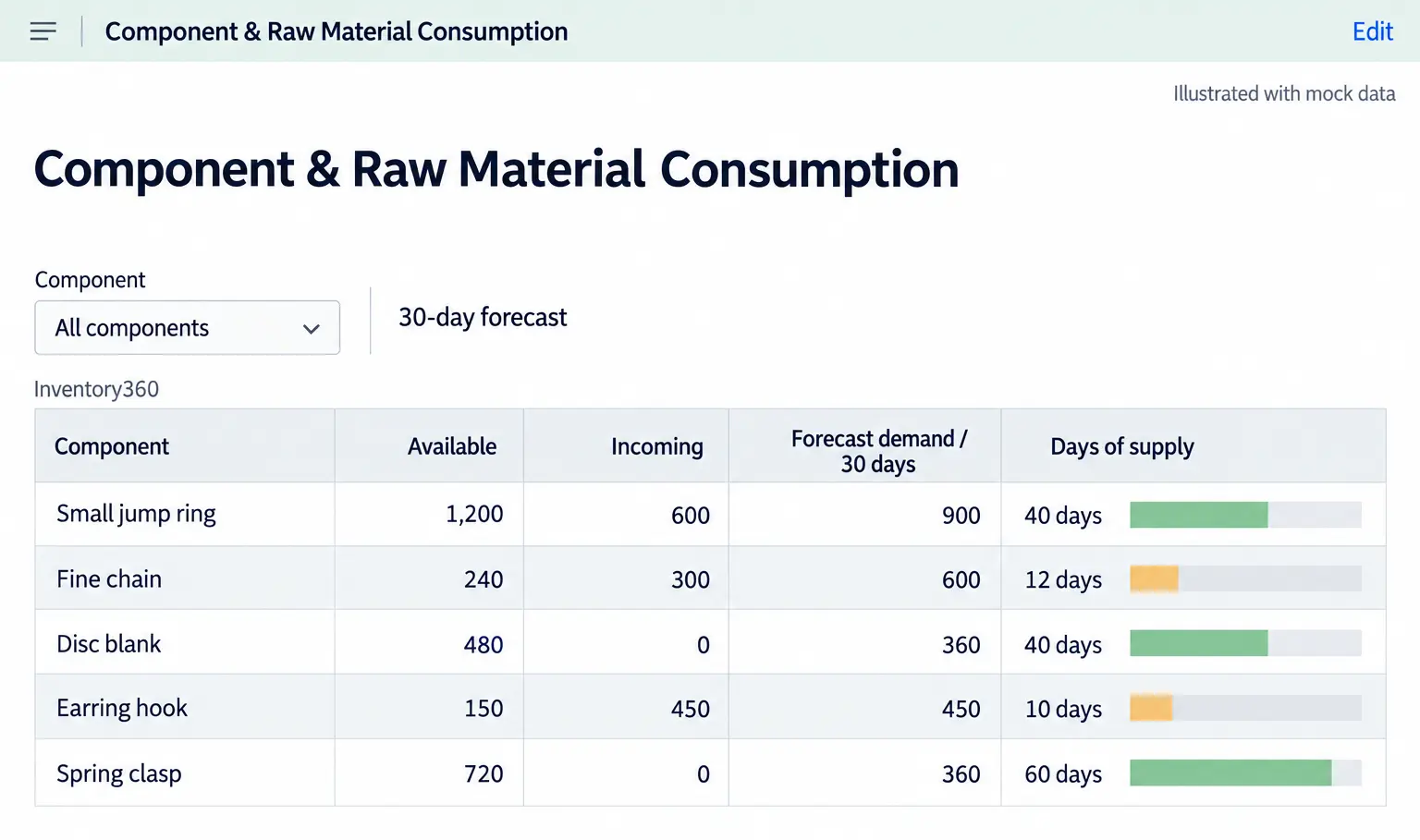 Inventory360 in Sigma: stock, incoming orders, and 30-day forecast demand for each component, with days of supply flagged when it runs short. Illustrated with mock data.
Cost and margin information ready for pricing decisions
Automating data ingestion and unification also changed how GLDN approached pricing. Previously, the manual effort required limited pricing reviews to every few months.
Now cost and contribution-margin information is available directly in Sigma, GLDN’s business intelligence tool. Sigma enables analysis across many dimensions, including product, metal type, and vendor. The product and finance teams can now see how changing material costs affect margins and make targeted price adjustments.
“Margins and pricing are a bit of a black box before we got the data warehouse in place. I can’t overstate how essential it was to get visibility into these metrics during a turbulent period of tariffs and metal market swings. Getting the data flowing was an absolute game changer for the team.”
— Eric Tucker, Head of Data & Technology, GLDN
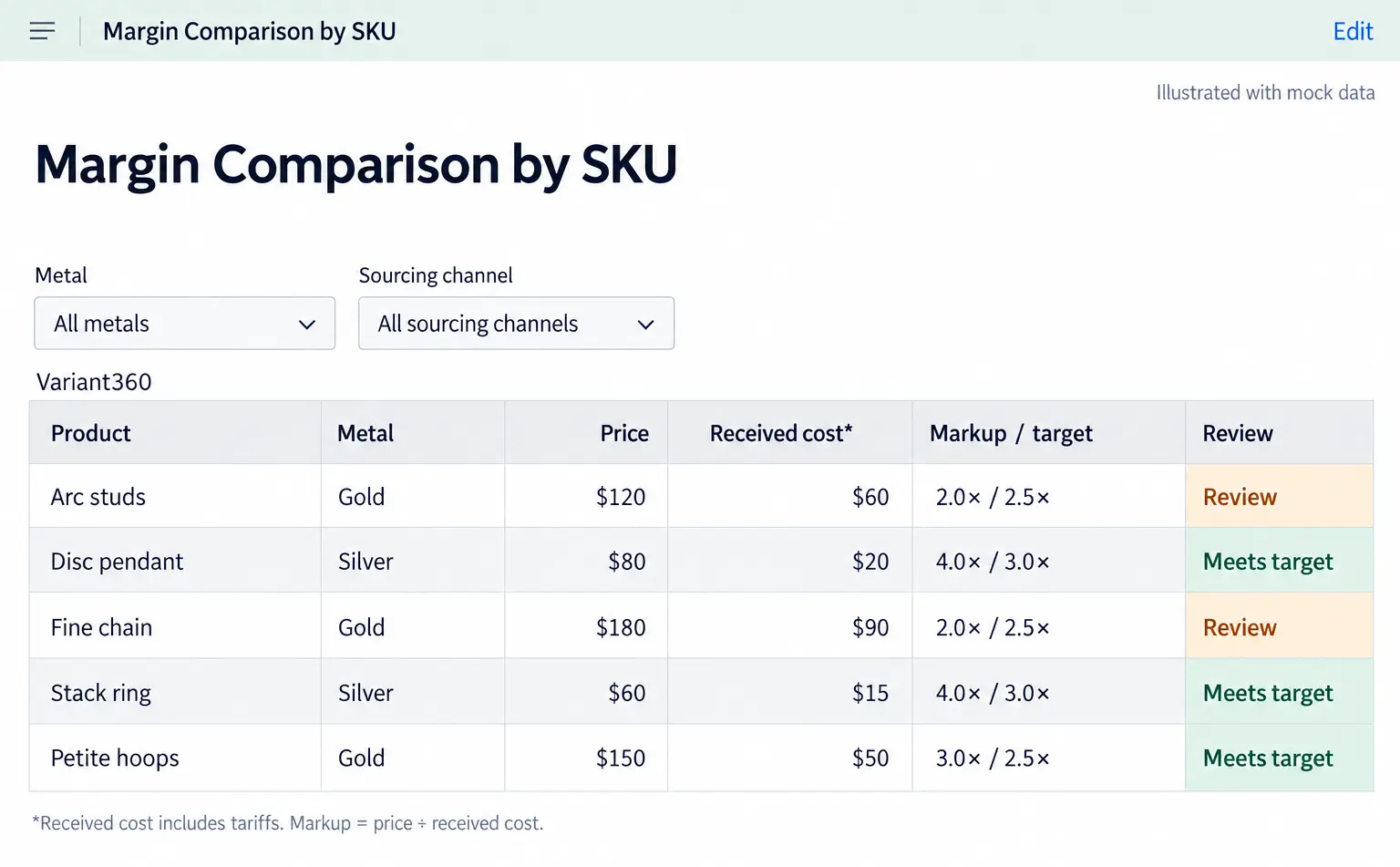 Variant360 in Sigma: price, received cost including tariffs, and markup against target for each SKU, filterable by metal and sourcing channel. Illustrated with mock data.
From weeks of preparation to decisions in days
In Q1, GLDN reported that forecasting and ordering time dropped from weeks to days, while forecast accuracy for key vendors improved to within 10% of actual demand. Additionally, purchase-order receipt reconciliation dropped from hours to minutes.
Contribution margins remained strong during the same period, even as gold and silver prices rose sharply before retreating from their January peaks. Product-level margin visibility helped the product and finance teams make targeted price adjustments as material costs changed.
“Centralizing our data enabled much more rapid reconciliation and decision making, freeing finance and purchasing for higher-value work.”
— Eric Tucker, Head of Data & Technology, GLDN
For GLDN, unified data means more time to act when timing matters most. Purchasing can now better plan ahead of seasonal demand, and product and finance teams can adjust pricing as material costs change.
The team is better equipped to keep popular pieces available and protect the profitability of each sale, with a clear view of demand, inventory, and margins.
Looking forward: building on the foundation with AI
The foundation is set for AI to use centralized data to answer real business questions. GLDN is piloting an AI assistant designed to help its teams better understand and apply data to their business areas.
The initial focus is answering everyday questions in Slack, such as where a number in Sigma comes from or how a metric is calculated, with the ability to inspect the underlying code and query history. This next evolution is meant to make that knowledge easier to access, giving teams more confidence in the information behind purchasing and pricing decisions while freeing the data team to focus on further building out the data systems and company context.